
McCulloch Projected Versus Actual Release
TDCJ uses the exact label “Projected Release Date.” Classification and Records calculates it as the expected release from incarceration if parole does not occur sooner. It is not the parole eligibility date, maximum sentence date, a promise, or proof that release happened. An actual release is a completed custody event supported by a release certificate, booking-out entry, or discharge record.
A McCulloch County pretrial detainee is different. Bond may authorize release, yet another cause, warrant, or detainer can keep the person confined. The court record explains authority. The Sheriff's jail register shows when the person left McCulloch custody or transferred. Pair both when timing matters.
Find McCulloch Inmate Release Dates
Begin with custody, not the date field. The TDCJ offender search is right for a state prisoner. The McCulloch Sheriff and sentencing court are right for a county jail term. A transfer from the county jail to TDCJ changes the source and may create a data-entry delay.
- Confirm whether the person is in McCulloch County Jail or TDCJ.
- For TDCJ, search by TDCJ number or SID when possible.
- Match identity, offense, conviction county, sentence, and unit.
- Read projected release with maximum date, eligibility, and parole action.
- For county time, request the signed order, jail-credit calculation, and release record.
The VINELink Release Check explains current IVSS alerts, but an alert does not replace the source record.
McCulloch TDCJ Release Fields
TDCJ details can show several dates that answer different questions. A number match is safer than a name. Data update on working days and are at least 24 hours old, so call the unit before arranging a pickup.
| Field | Meaning |
|---|---|
| Projected Release Date | Current calculated prison-release projection if parole is not sooner |
| Maximum Sentence Date | Calculated endpoint of the sentence |
| Parole Eligibility | Earliest consideration point, not release |
| Latest parole decision | Panel action that may affect processing |
| Unit or location | Current TDCJ location, subject to lag |
If the current search no longer returns the person, use TDCJ's offender information service. Give full name and seven-digit TDCJ number. If unknown, give birth date, or approximate age and conviction county. Ask for incarceration history and release or discharge information.
The official search is a current inmate service, not a complete archive of all discharged people. A failed name query therefore does not prove release. Court history, the TDCJ email response, and a release certificate provide a more durable trail.
Read McCulloch TDCJ Results
The official TDCJ search screen shows the entry fields used to locate the correct state prisoner.
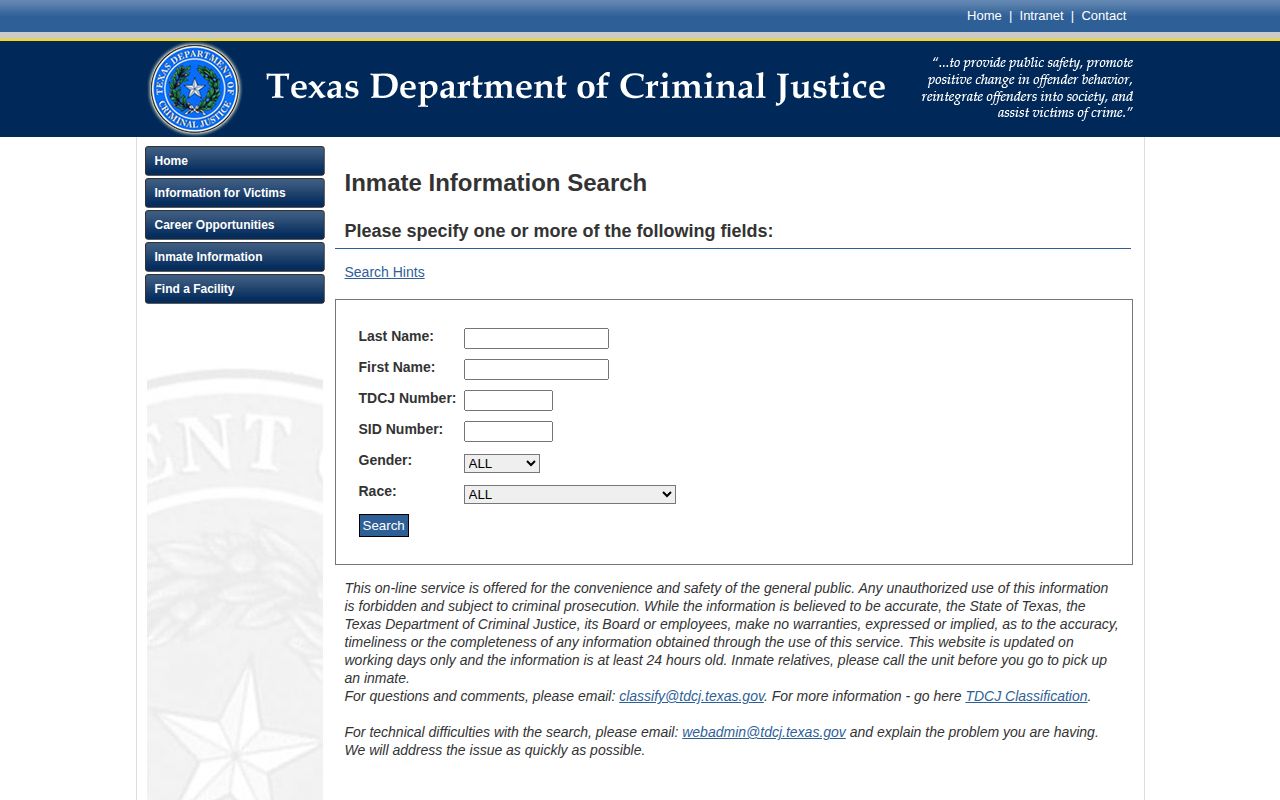
Use the number fields when known, then confirm the conviction county and sentence before reading any projected date from the detail.
TDCJ's official definitions explain how the agency uses the projected-release label.
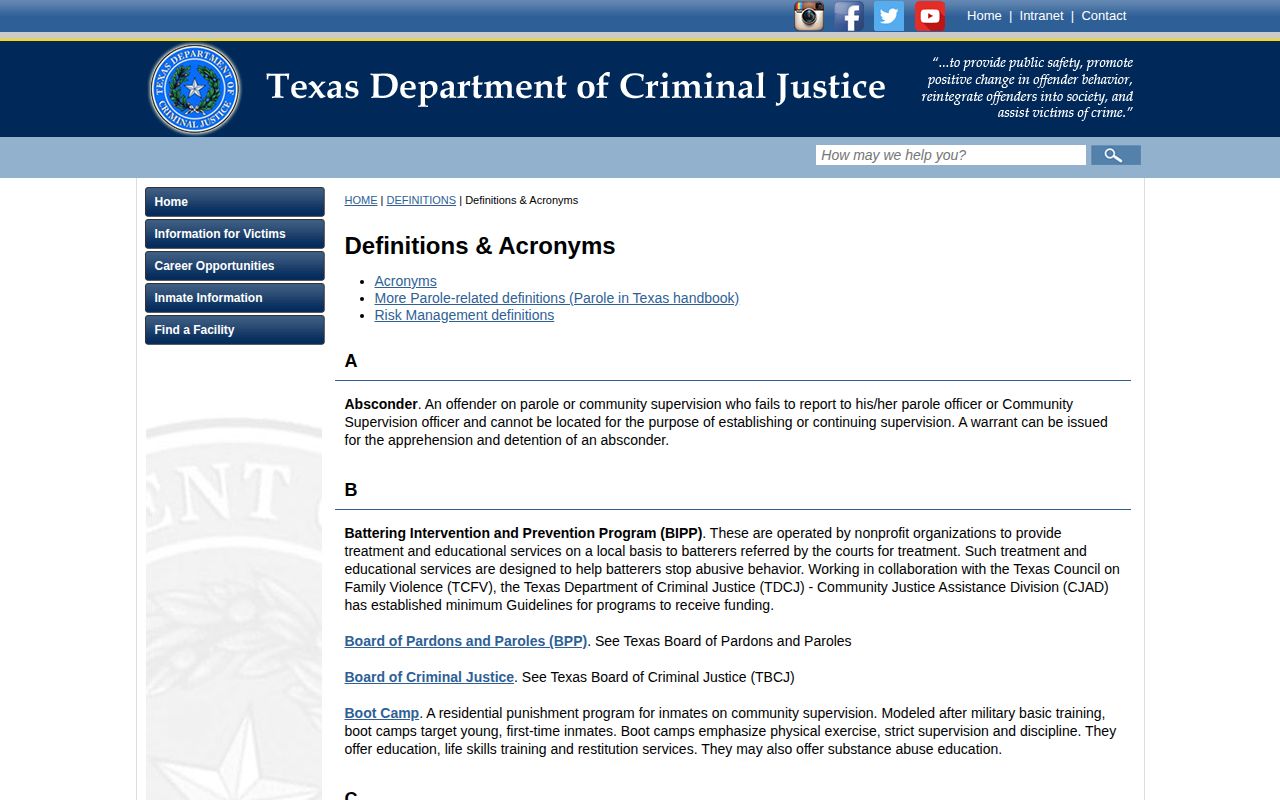
The definition makes the central limit plain: the date is a calculation for release from incarceration if parole does not occur sooner, not proof of a completed exit.
Texas Good Time Release Rules
Government Code Chapter 498 governs good conduct time. Credits affect classification and eligibility calculations as law allows. They do not simply reduce every judicial sentence or guarantee release to the community. Offense date, offense type, sentence structure, mandatory-supervision eligibility, discipline, and Board action matter.
For certain eligible offenses before September 1, 1996, flat time plus good time can reach the mandatory-supervision point. For an eligible later offense, that point also requires discretionary Board approval. A denial can move the projection to maximum expiration. Later approval can move it earlier. An ineligible offense generally projects to maximum expiration using flat time.
Parole eligibility under Government Code Chapter 508 varies too. The general formula uses calendar time plus good conduct time equal to one-fourth of the sentence or 15 years, whichever is less. Specified serious cases require actual calendar time equal to one-half of the sentence or 30 years, whichever is less, with a two-year minimum. Eligibility still is not release.
Why McCulloch Release Dates Move
A changed date is not, by itself, proof of error or punishment. TDCJ can recalculate after a record audit, sentence change, Board decision, or credit event. Read the surrounding fields first.
| Factor | Possible effect | Confirm with |
|---|---|---|
| Good-time loss or restoration | Moves a calculation | TDCJ credit record |
| Mandatory-supervision decision | May move projection to maximum or back | BPP decision |
| Parole approval | Starts audit and processing | BPP and release processing |
| Sentence or court change | Rebuilds the calculation | Judgment and TDCJ record |
| Detainer or warrant | May cause transfer | Holding and receiving agencies |
A favorable parole vote does not set gate time. Review and Release Processing checks the plan, county requirements, programs, discipline, conditions, and certificate. Even a scheduled date may change without notice.
Confirm McCulloch Actual Release
After the projected date passes, identify the record that proves the event. For TDCJ parole or mandatory supervision, use the certificate and Parole Division trail. Direct discharge means the sentence ended without parole supervision. For McCulloch County Jail, request the jail register entry and booking-out materials. The permanent register includes the release or transfer date.
A state release means release from that custodian. It does not rule out county, federal, or immigration custody. A McCulloch roster disappearance is also only a display change. Ask whether the person left for the community, TDCJ, another county, ICE, or U.S. Marshals.
- Parole
- Conditional release from prison under state supervision.
- Mandatory supervision
- A supervised release mechanism governed by credits and Board review.
- Direct discharge
- Sentence completion without parole supervision.
- Detainer
- A hold or request for another custodian.
McCulloch County Time Calculations
Texas has no blanket rule requiring every inmate to serve 85 percent. Importing that shorthand can produce a false date. State rules turn on the offense, date, sentence, credits, exclusions, and Board action. McCulloch County has not published a local jail good-time formula or weekend-release policy.
For a county sentence, ask the Sheriff for the calculation sheet and conduct-credit record, along with the signed judgment. Texas retention series PS4200-07 keeps conduct and good-time records for at least release or transfer plus two years. That is the exact local path when a date cannot be rebuilt from the order alone.
The Sheriff is at 900 East Main Street, Brady, TX 76825, 325-597-0639. Ask which sentence and credits were used, whether another hold exists, and whether the event is release or transfer. No jail lobby hours were verified.
Note: A McCulloch calculation record explains the date used by the jail, while the signed court order supplies the legal sentence and credited time.
McCulloch Court Date Checks
The 452nd District Court record can explain a felony sentence, jail credit, later modification, or revocation. A judgment marked time served may explain why release was authorized, but it may not state the physical gate time. Pair it with the Sheriff's register. One dismissed count also does not defeat a hold in another cause.
For a county-level misdemeanor or municipal matter, identify the proper clerk and court before requesting the order. Preserve the cause number. A docket is an index of events; the signed order is stronger proof. A scheduled hearing is not a result, and a motion is not a final ruling.
When dates conflict, ask each source a narrow question. The court should confirm the sentence and legal order. The jail should confirm credits, other holds, and booking-out time. TDCJ should explain the state calculation after transfer. This separation keeps a McCulloch County projected date from being mistaken for an actual release.
McCulloch Parole Date Limits
Parole review starts before eligibility, and a three-member panel votes the file. Two matching votes make the result final. Approval codes still require care. FI-1 means release when eligible, FI-2 names a future month and year, and an R-designated approval can require a program. RMS refers to mandatory supervision. None proves the person left prison.
Before a vote, person-specific status is available through TDCJ or the Board line at 844-512-0461. After favorable action, Review and Release Processing can be reached at 512-406-5202. That office audits the record, release plan, programs, conditions, and destination. The release certificate is stronger evidence than the vote date.
If a projection moves later after a mandatory-supervision denial, compare the offense date and type, eligibility, Board decision, maximum date, discipline, sentence changes, and time credits. A later approval may move it earlier. Describe the result as recalculation unless the actual record establishes another cause.
McCulloch Release Date Scenarios
A name that disappears from the current roster has no proven release date yet. Record only that it no longer appears as of the check. Call the jail and ask for the release or transfer event. If the register shows transfer to TDCJ, describe a transfer and move to the state search after the expected lag.
A bond order also needs a second source. Confirm every cause and hold, then ask the jail for booking-out time. The sound statement separates the court's authority from the Sheriff's physical event. The pending case does not end merely because bond was posted.
A projected TDCJ date that moves later requires comparison, not guesswork. Mandatory-supervision eligibility, Board action, maximum expiration, discipline, consecutive sentences, and court changes can all matter. A date can later move earlier after approval or correction. Do not label the movement punishment or error without the record.
Request McCulloch Date Records
For county time, request the signed judgment, commitment, jail-credit calculation, conduct or good-time record, booking-out form, and jail register. Give full name, booking number if known, cause number, and a narrow date range. Ask the Sheriff to identify any recorded hold and whether the endpoint was community release or transfer.
For TDCJ history, email pia@tdcj.texas.gov with full name and the seven-digit TDCJ number. Without the number, provide an exact birth date or approximate age and conviction county. Ask for prior incarceration history, admission, projected-release information, release or discharge, and an explanation of the ending status.
For a current state prisoner, general inmate information is available at 936-295-6371 or 800-535-0283 on weekdays from 8 a.m. to 5 p.m. Use the unit for pickup confirmation. Dates can change even on the scheduled day, so do not make travel plans from an old screenshot alone.
McCulloch Release and Discharge Dates
The prison exit date and supervision discharge date are different. A parole or mandatory-supervision certificate states the reporting destination and conditions. Its later sentence-discharge date marks the end of supervision, not the day the person left prison. Direct discharge joins sentence completion and prison exit without a parole term.
Probation is another distinct path. It is imposed by the sentencing court and administered through a local Community Supervision and Corrections Department. A probation order can explain why someone is outside jail, but it may not include the physical booking-out time. Use the court order and Sheriff record together.