
McCulloch Parole and Probation
Parole begins after a person leaves Texas prison under a release decision by the Texas Board of Pardons and Paroles. The TDCJ Parole Division then manages the case. Probation is different. A McCulloch County court orders community supervision as part of a sentence, and a local Community Supervision and Corrections Department, or CSCD, administers it. A person can therefore be outside jail under probation without ever having been paroled from TDCJ.
The source must match the status. The county jail roster is not a parole or probation list. TDCJ information can support parole status, while a signed judgment or community-supervision order supports probation. McCulloch County links the 452nd Judicial District CSCD, but the outside CSCD website was unavailable during the research review. No reporting hours or public person-search procedure could be verified, so those details should come from the office or current court record.
| Status | Who orders it | Best verification record |
|---|---|---|
| Parole | Texas Board of Pardons and Paroles | TDCJ status, release certificate, and Parole Division record |
| Mandatory supervision | Texas law and BPP review where required | TDCJ status and release certificate |
| Probation | Sentencing court | Judgment, community-supervision order, and later court orders |
| Direct discharge | Sentence reaches its end | TDCJ incarceration history or discharge record |
- Parole
- Conditional release from state prison before the sentence fully expires.
- Probation
- Court-ordered community supervision, also called community supervision in Texas.
- Direct discharge
- Release when the sentence ends without parole supervision.
- Mandatory supervision
- A supervised prison release based on statutory time-credit rules and, in some cases, discretionary review.
Check McCulloch Supervision Records
Begin with the last known custody and the criminal cause number. A prison release points toward TDCJ and BPP. A sentence imposed in a McCulloch court may instead point to probation. Names alone can produce a false match, so compare a TDCJ number, SID, birth information, conviction county, offense, and sentence details when the record supplies them.
- Search the TDCJ inmate information service. Read the current location, projected date, parole eligibility, and latest review or decision as separate fields.
- For parole status before release, use the BPP status line at 844-512-0461. A favorable vote is not the prison exit date.
- After favorable action, confirm processing through Review and Release Processing at 512-406-5202, then obtain the release certificate or actual event record.
- For probation, search the McCulloch criminal cause and obtain the signed judgment or community-supervision order from the proper clerk.
- Check later orders for modification, revocation, discharge, or judicial clemency. A docket entry is a lead; the signed order is stronger proof.
TDCJ states that its online information updates on working days and is at least one day old. A blank search does not prove discharge. For past incarceration, a focused request to pia@tdcj.texas.gov can seek incarceration history using the full name and TDCJ number, or birth information, approximate age, and conviction county when the number is unknown.
The official TDCJ search shown in this captured screen is a suitable starting point for state supervision.
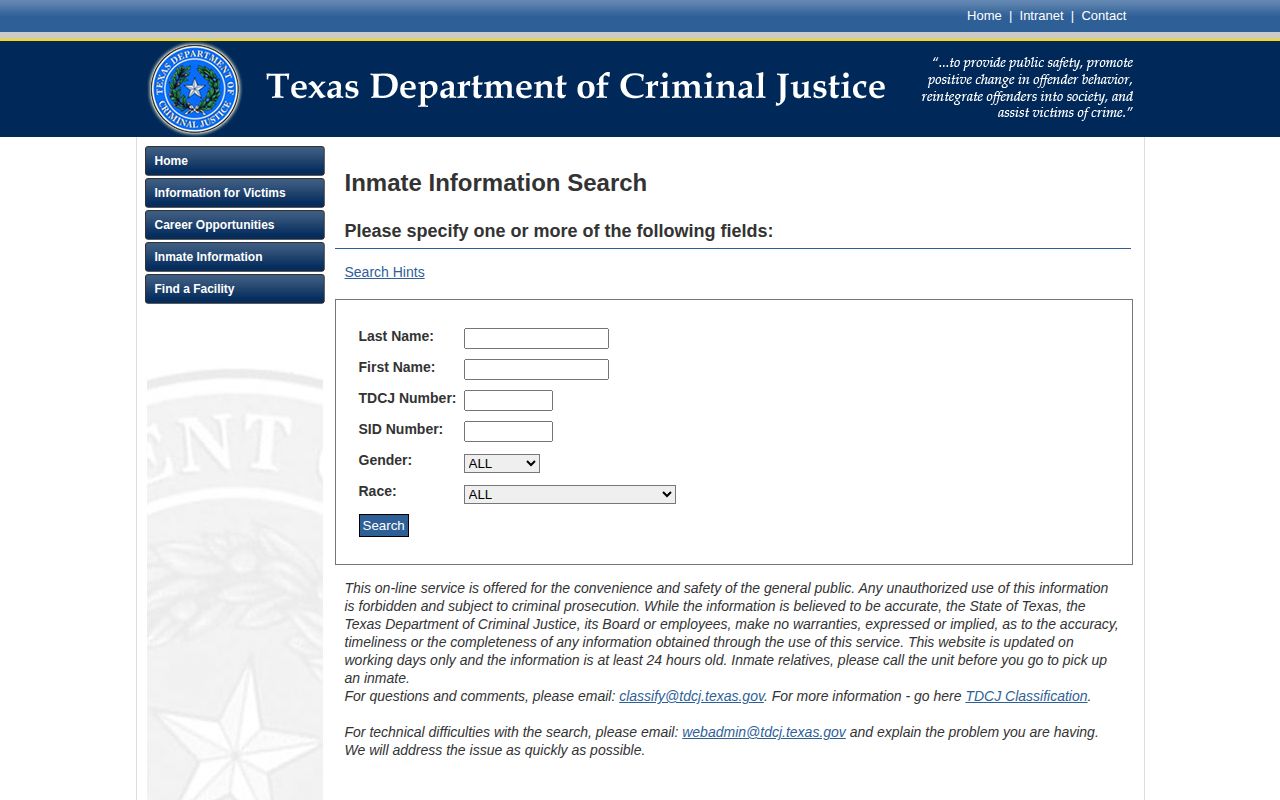
Its result fields must be read with the release certificate and current status channel, not as a complete archive of every former inmate.
McCulloch Parole Vote Meaning
BPP review begins before eligibility. TDCJ identifies a case months before its review, an institutional parole officer prepares the file, and a three-member panel votes in sequence. Two matching votes make the result final. That process decides whether release may move forward, but it does not record when a person walked out of a unit.
The decision code matters. FI-1 means release when eligible. FI-2 names a future month and year. An approval with an R condition requires a treatment or program step. RMS means release to mandatory supervision. Denial codes include NR with a later review, SA or serve-all, DMS with a later mandatory-supervision review, and CU variants tied to consecutive sentences. A favorable code can still be followed by plan review, a legal hold, a required program, or an audit.
McCulloch Probation Office Trail
Texas does not provide a verified statewide public person search for probation. For a McCulloch case, the court record is the reliable public trail. Look for the order that placed the person on community supervision, its term and conditions, any later modification, a motion to revoke or adjudicate, the court's ruling, and a final discharge or judicial-clemency order.
A motion to revoke is only a filing until the court acts. It does not by itself prove arrest, absconding, or revocation. The same care applies to deferred adjudication, which is a community-supervision disposition rather than an acquittal. The 452nd District docket and District Clerk serve felony causes. County-level misdemeanors normally go through the County Court and County Clerk.
McCulloch District Clerk199 Courthouse Square, Room 103
Brady, TX 76825
325-597-0733 ext. 1
Monday through Thursday, 8 a.m. to 5 p.m.; Friday, 8 a.m. to 3 p.m.
Ask the CSCD for any confirmation it may lawfully provide, but use the signed court order for the legal status. The probation order may explain why the person is outside jail, yet it may not carry the sheriff's physical booking-out time.
McCulloch Parole Absconder Status
TDCJ defines an absconder as a releasee who stopped reporting and whose location is unknown. The Parole Division's 24-hour tip line is 866-680-6667. It is not a general warrant search and cannot turn a missing online result into proof that a named person absconded. Current parole supervision or conduct questions go to io@tdcj.texas.gov, while public-information requests for Parole Division records go to pia@tdcj.texas.gov.
Parole conditions can include reporting, residence, travel, treatment, monitoring, or other person-specific limits. The release certificate and later supervision records show what applies. Probation conditions come from the court order. If a violation is alleged, read the motion, warrant or detainer, hearing record, and final ruling rather than compressing them into one claim.
Texas IVSS notifications can report some custody or status events, but county and state systems are separate. IVSS-Counties covers participating county custody and court events. TDCJ IVSS covers prison and parole. An alert is timely evidence of an agency event, not a certified supervision record.
McCulloch Supervision Discharge Records
Parole or mandatory supervision usually ends on the sentence-discharge date stated in the governing TDCJ record, unless a later action changes the status. That date is distinct from the earlier prison release date. A probation term ends as the final court order states. Seek a discharge order when one exists, and check the docket for later action on the same cause.
Revocation changes the path. A parole revocation may return the person to TDCJ. A probation revocation judgment may impose custody or another disposition. Neither result should be inferred from a hearing setting. When physical release time also matters, pair the legal order with the jail register or TDCJ event. The broader McCulloch County released-inmate search explains how to match the custodian's record with the court result.
Discharge does not mean every public record disappears. Expunction under current Texas law and nondisclosure under Government Code Chapter 411 have separate rules and effects. A valid expunction order can require covered records to be removed, returned, or destroyed. Nondisclosure limits public disclosure but is not the same as erasure.
When a discharge record is hard to locate, preserve the cause number and ask for the final case history rather than searching only by name. A person may have more than one cause, and the end of supervision in one cause does not resolve another. Court records follow the clerk's access rules, while TDCJ and sheriff records use their own public-information channels. This source split matters because Texas courts are not ordinary Public Information Act agencies. The final order remains the best legal proof of a probation discharge, and the TDCJ record remains the best source for the end of state parole supervision.
Which McCulloch Record Proves Release?
A McCulloch supervision record and a gate record answer different questions. The release certificate identifies parole or mandatory-supervision conditions and reporting destination. A probation order identifies a court-imposed status. The county jail register records release or transfer from local custody, while TDCJ history documents the end of state confinement.
This split is the county's key verification detail. Do not use a parole approval as a release timestamp. Do not use a probation order as proof of a jail exit. When the outcome matters, state the source beside the claim: court order for legal authority, jail register for local booking-out, TDCJ certificate for supervised state release, and discharge record for the supervision endpoint.